

Cart
0
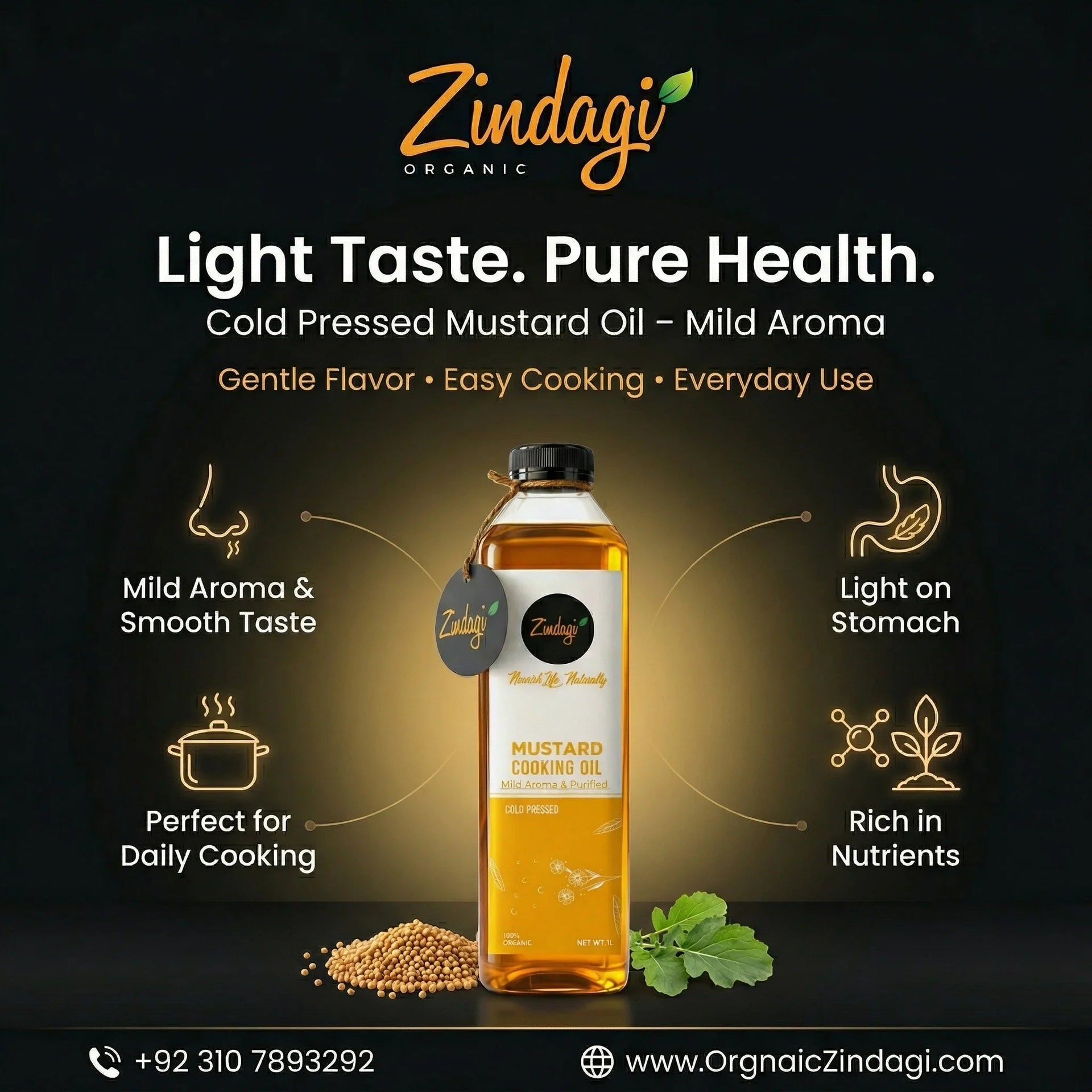
How to Know If Your Mustard Oil Is Actually Organic
Walk through any online store in Pakistan selling mustard oil and you'll find the same words on almost every listing: organic, pure, natural, chemical-free, cold-pressed. They appear on bottles from industrial refineries and from operations running a single small press. They appear whether the seed came from a certified farm or a wholesale market where nobody asked.
"Organic" printed on a label costs nothing. What makes mustard oil actually organic is a specific chain of decisions made long before the bottle is filled — and most brands selling in Pakistan today won't tell you what that chain looks like, because they don't control it.
Here is what actually matters, and how to check each one.
1. Where Did the Seed Come From?
This is the question the word "organic" is actually answering — and it's the one almost nobody asks.
Organic certification in food applies to farming, not pressing. It certifies that the seed was grown without synthetic pesticides, synthetic fertilizers, or prohibited substances. Cold-pressing is a method; organic is a source. A cold-pressed oil can be made from conventionally farmed seed full of pesticide residue. An organic-certified oil must start from certified organic farming.
Most brands selling mustard oil in Pakistan buy seed from open wholesale markets. At that point, the seed's origin is unknown — it could be from multiple farms, multiple regions, mixed at aggregation. There is no way to trace it, and therefore no meaningful basis for an organic claim.
What to look for: Does the brand state where their seed comes from? Own farmland, named contracted growers, or a specific region? If the answer is "carefully selected seeds" with no further detail, the origin is unknown.
What Organic Zindagi does: Our mustard seed is grown on our own farmland. We control the farming, which is why we can speak to what goes into the seed before it goes into the press.
2. How Is It Pressed?
Cold-pressing — mechanical extraction without heat above approximately 40°C and without chemical solvents — preserves the oil's natural vitamins, antioxidants, and the glucosinolates that give mustard oil its characteristic bite.
Industrial refining does the opposite. It uses hexane solvent extraction to maximise yield, then bleaches, deodorises, and dewaxes the result. The output has a longer shelf life and a neutral flavour. It also has a fraction of the nutritional profile of the original oil.
The distinction matters because refined oil and cold-pressed oil look similar in the bottle, and both can be labelled "pure mustard oil."
What to look for: Cold-pressed, mechanical extraction, no solvents, low temperature. If the label says "refined" or the price is dramatically lower than comparable cold-pressed oils, refining is likely involved.
How to test at home: Put 100ml of oil in a clean glass bottle and refrigerate it at 4°C for six hours. Genuine cold-pressed mustard oil will partially solidify — forming soft cloudiness or waxy flakes — because of its natural saturated fats and waxes. Fully refined or adulterated oil stays completely liquid and clear.
A second test: put one drop on uncoated white paper and wait ten minutes. Pure mustard oil leaves a semi-transparent, slowly spreading stain with a faint yellow halo. Adulterated oil spreads rapidly and leaves a greasy ring.
3. What Are the Common Adulterants?
A 2023 Consumer Rights Commission of Pakistan study found that 41% of supermarket private-label mustard oils contained detectable palm oil traces. A recent government report found that 75% of refined palm oil samples tested in Pakistan failed national standards.
The most common adulterants in Pakistani mustard oil are:
Palm oil — colourless and odourless, added to cut costs. Detectable by the refrigeration test: palm oil hardens in cold temperatures and forms white clumps in the bottle.
Argemone oil — toxic, extracted from a weed that grows alongside mustard crops. Can cause nausea, vomiting, liver and kidney damage. Detectable by the nitric acid test: add equal parts oil and nitric acid in a test tube. Pure mustard oil shows no colour change. Adulterated oil turns orange to red.
Mineral oil — industrial oil added for volume. Not safe for consumption. Burns with black, sooty smoke rather than the steady blue-tinged flame of pure mustard oil.
What to look for: A strong, distinctively pungent aroma is a basic freshness indicator. The compound allyl isothiocyanate is what gives mustard oil its sharp character — an oil that smells mild, neutral, or perfumed should raise questions. Rub a few drops between your palms: pure mustard oil has a sharp smell that can give a faint eye irritation. No pungency, or a synthetic smell, is a red flag.
4. Is the Certification Real?
Halal certification and organic certification are two distinct things, and brands regularly display one while implying both.
Halal certification covers the processing facility and packaging — it certifies that no prohibited substances entered the oil during production. Most credible Pakistani food manufacturers hold this, or their packaging supplier does.
Organic certification covers farming — it certifies the seed origin. This is harder to obtain, requires field inspection of actual farmland, and needs to be renewed. It is also the certification most brands claiming "organic" do not publicly display, because they don't hold it for the farming stage.
What to look for: The certifying body's name, not just a logo. A certificate number. An expiry date. A way to verify it — most legitimate certifying bodies maintain a searchable online registry. If a brand displays a Halal logo but cannot point you to an organic farming certificate with a named body and number, the organic claim applies to the process at best, not the source.
5. What Does the Label Tell You?
Legitimate food manufacturers operating under Punjab Food Authority licensing are required to include specific information on packaging. Check for:
- Manufacturing date and expiry date
- Batch number — this is your traceability link if you ever need to query a specific batch
- Manufacturer's name and physical address — not just a brand name or a city
- Ingredient list — for pure mustard oil, there should be one ingredient: mustard oil
A brand with no physical address on the label, or one that lists only a city with no street address, has given you nowhere to go if you have a question.
What to Actually Ask Before You Buy
When choosing a mustard oil, five questions cut through most of the marketing:
- Where does your seed come from? Own farm, contracted growers, or wholesale market?
- Is your organic certification for the farming or the processing? These are different things.
- Can I see the certificate? Certifying body, number, expiry date, and ideally a link to verify.
- Where is the oil pressed? Own facility or outsourced?
- Is there a batch number on the bottle? If yes, can I access the lab report for that batch?
A brand that can answer all five specifically and in writing is operating at a different standard from one that answers with adjectives.
Why We Wrote This
At Organic Zindagi, our mustard seed is grown on our own farmland. It is cold-pressed at our own facility in Gujranwala — a manufacturing operation that has been running since 1976. Our packaging is food-grade and Halal-certified, supplied by a Lahore manufacturer operating since 1965. Our products are laboratory tested for purity and we hold a Punjab Food Authority licence.
We can answer all five questions above. We wrote this piece because we think every brand selling organic food in Pakistan should be able to.
If you want to check any of it, the details are on our About page. If you want to test the oil itself, the refrigeration test above works — put our mustard oil in the fridge tonight and see what happens in the morning.


