

Cart
0
Quick answer: Vanaspati ghee is not ghee at all — it's partially hydrogenated vegetable oil, a 1950s industrial invention built to imitate the taste and texture of real ghee at a fraction of the cost. It can contain up to 40–50% industrial trans fat in some Pakistani brands. The World Health Organization calls industrial trans fat a toxic chemical with no safe level of consumption, and as of 2023, 53 countries — covering 3.7 billion people — have passed laws to eliminate it from their food supply. Pakistan itself only closed this gap in March 2025.
This is not a fringe health claim. It's one of the most well-documented issues in global food policy, and it's directly relevant to nearly every kitchen in Pakistan.
What Vanaspati Ghee Actually Is
Real ghee is clarified butter — a dairy product that has existed in South Asian kitchens for thousands of years. Vanaspati ghee shares none of that origin. It is made by taking liquid vegetable oil (usually cottonseed, soybean, or palm oil) and pumping hydrogen gas through it at high temperature, using a nickel catalyst to force the liquid oil to become solid at room temperature. This process is called hydrogenation, and it was never part of any traditional food system — it's a 20th-century industrial shortcut designed to produce something that looks, spreads, and melts like ghee without the cost of dairy.
The problem is what hydrogenation creates along the way: industrial trans fatty acids (iTFA) — molecules that essentially don't exist anywhere in nature and that the human body has no efficient way to process.
The Trans Fat Problem, in Plain Language
Trans fat doesn't just add "some" risk — it works against your heart from two directions at once. Research summarized by the Pan American Health Organization shows industrially produced trans fat raises LDL ("bad") cholesterol while simultaneously lowering HDL ("good") cholesterol — a combined effect that's more damaging to your cardiovascular system than saturated fat alone.
Globally, industrially produced trans fat is estimated to cause roughly 500,000 premature deaths from coronary heart disease every year. That statistic isn't abstract for Pakistan — multiple public health reviews have identified Pakistan as having the second-highest per-capita trans fat intake in the world, and a 2025 regulatory review estimated that industrial trans fat consumption contributes to more than 15,000 deaths in Pakistan annually.
The Global Response: WHO's REPLACE Initiative
In 2018, the World Health Organization launched REPLACE, a global roadmap with one target: eliminate industrially produced trans fat from the world's food supply. Governments were pushed toward two "best-practice" policy options:
- A mandatory limit of no more than 2 grams of industrial trans fat per 100 grams of total fat, across all foods, or
- An outright ban on the production and use of partially hydrogenated oils.
The results, tracked in WHO's 2023 five-year milestone report:
- 53 countries now have best-practice trans fat policies in effect
- These policies protect 3.7 billion people — 46% of the world's population — up from just 6% coverage in 2018
- WHO estimates these policies prevent roughly 183,000 deaths every year
- Countries such as Denmark, Canada, Thailand, and the United States were early adopters; Denmark's 2003 law limiting trans fat to 2% became the global template other nations copied
So the framing that vanaspati-style hydrogenated fat is being "banned and restricted worldwide" isn't marketing language — it's a documented, WHO-tracked policy shift covering nearly half the planet.
What Changed in Pakistan (This Is New — 2023 to 2025)
For years, Pakistan lagged badly on this issue. As recently as 2020, the Pakistan Standards and Quality Control Authority (PSQCA) allowed vanaspati ghee to legally contain up to 5% trans fat — more than double what WHO considers safe.
That has changed fast, in three stages:
| Date | What Happened |
|---|---|
| 2020 | PSQCA sets a 5% trans-fat limit for vanaspati ghee only |
| June 2023 | Limit tightened to 2% (WHO best practice), but only for 6 food categories — vanaspati, margarine, bakery fats, biscuits, rusks, bakery wares |
| September 2024 | Coverage expanded to 58 food categories |
| March 25, 2025 | PSQCA passed a national standard limiting industrial trans fat to under 2% of total fat across all food categories — aligning Pakistan fully with WHO's global best practice |
In other words: the 2% trans-fat ceiling that health authorities have been demanding for years is now, as of 2025, the law of the land in Pakistan — not just a foreign standard you read about in a WHO report. Products manufactured or sold above that threshold are no longer meeting the country's own regulatory standard.
How Vanaspati Compares to Cold-Pressed Oil, Side by Side
| Vanaspati Ghee | Zindagi Cold-Pressed Oils | |
|---|---|---|
| Extraction method | Hydrogen gas + nickel catalyst at high heat | Mechanical cold pressing only, below 40°C |
| Trans fat | Historically up to 40–50% in some brands; now legally capped at 2% | 0g — physically cannot form without hydrogenation |
| Nutrients | Destroyed by processing; nothing natural remains | Vitamin E, Vitamin K, Omega-3, and antioxidants fully retained |
| Colour, smell, texture | Artificially created to imitate real ghee | Natural to the seed — golden mustard, nutty sesame, etc. |
| Chemicals used | Hydrogen gas, nickel catalyst, bleach, deodorants | None |
| Traditional food status | Invented in the 1950s as a cost substitute | Centuries-old extraction method (Kachi Ghani) |
What This Means for Your Kitchen
You don't need to memorize chemistry to act on this. The practical takeaway is simple:
- If a product's label says "vanaspati," "partially hydrogenated," or shows no trans fat value at all, treat that as a reason to check further, not a reason to assume it's safe.
- Trans fat has no nutritional role and no safe minimum intake, according to WHO — unlike saturated fat, which at least serves some dietary function in moderation.
- The most protective swap isn't a brand — it's a method. Cold-pressed, mechanically extracted oils cannot contain industrial trans fat, because the chemical reaction that creates it (hydrogenation) never happens.
Frequently Asked Questions
Is vanaspati ghee banned in Pakistan?
Not banned outright, but as of March 25, 2025, Pakistan legally limits industrial trans fat to under 2% of total fat across all food categories, including vanaspati ghee — bringing it in line with WHO's global best-practice standard.
Is vanaspati ghee banned in other countries?
Several countries, including Canada, the United States, and Thailand, have banned partially hydrogenated oils outright — the primary source of industrial trans fat used to make vanaspati-style products. As of 2023, 53 countries worldwide have adopted WHO best-practice trans fat policies (a 2% limit or an outright ban), covering 46% of the global population.
What's the difference between vanaspati ghee and real ghee?
Real ghee is clarified butter, a dairy product. Vanaspati ghee is a plant-oil-based industrial product made through hydrogenation, designed to mimic ghee's taste and texture at lower cost. It shares no dietary or historical lineage with real ghee.
Why does trans fat matter more than other fats?
Most public health bodies, including WHO and the American Heart Association, note that industrial trans fat is unique in raising LDL ("bad") cholesterol while simultaneously lowering HDL ("good") cholesterol — a combined effect not seen with other fat types, which increases cardiovascular risk more sharply per gram consumed.
Can cold-pressed oil ever contain trans fat?
No. Trans fat in cooking oils is created specifically through industrial hydrogenation — pumping hydrogen gas through oil with a metal catalyst at high heat. Mechanical cold pressing never involves this reaction, so cold-pressed oils are inherently free of industrial trans fat.
The bottom line: This isn't a taste preference or a wellness trend — it's a documented global public-health shift that Pakistan's own regulators formally joined in 2025. Switching from vanaspati to a cold-pressed oil is one of the few dietary changes with direct, WHO-backed evidence behind it.
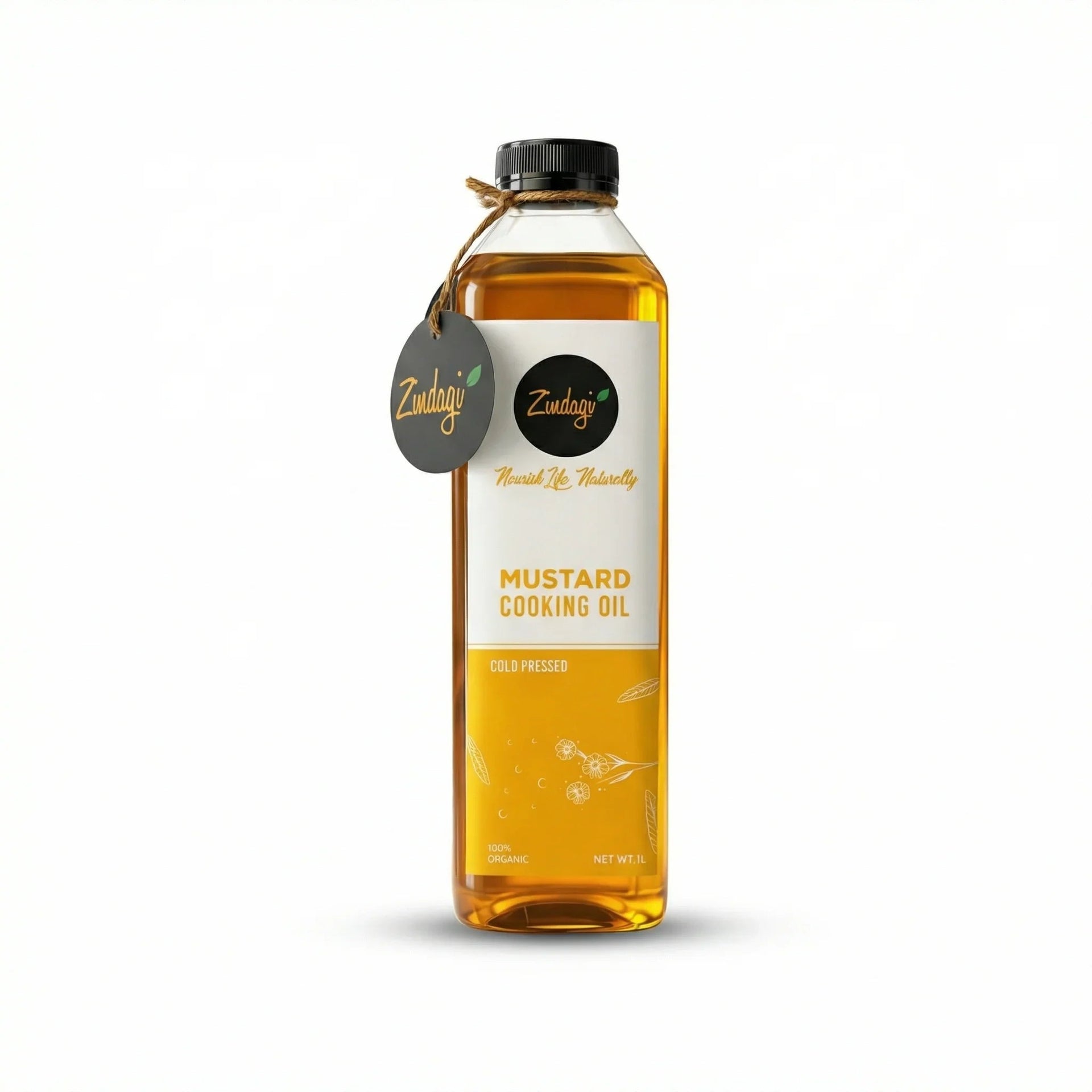
Zindagi Organic's cold-pressed mustard, sesame, coconut, and mild aroma oils are extracted mechanically with zero chemical processing and 0g trans fat, guaranteed by the method itself, not just a label claim.
Sources: World Health Organization REPLACE Initiative & 5-Year Milestone Report (2018–2023) · Pan American Health Organization (PAHO) · Pakistan Standards and Quality Control Authority (PSQCA) national trans-fat standard, March 2025 · NCD Alliance · The Express Tribune · The News International · Journal of Clinical Hypertension (Tarar et al., 2020)


